After a crash, one question sits at the center of everything: whose fault was it? The answer can affect who is legally responsible, how much compensation may be available, and whether an injured person can recover damages from another party. It feels like it should be simple. It rarely is.
In Florida, fault is more than a gut feeling about who made a mistake. It is a legal decision built on evidence, and the rules changed in 2023 in ways that raised the stakes for everyone involved. This guide explains how fault is decided in Florida, why your share of the blame matters so much now, and what you can do to protect yourself.
At Gold & Gold, P.A., we regularly review accident evidence to determine how fault should be allocated and to challenge insurance companies when they assign an injured person more blame than the facts support.
This article is general information about Florida law, not legal advice for your situation. Your case depends on facts only an attorney reviewing your accident, insurance, and medical records can evaluate.
How Florida Determines Fault After an Auto Accident
Fault in a Florida crash is decided by looking at who was negligent, meaning who failed to use reasonable care under the circumstances. More than one person can share the blame. Florida uses a rule called modified comparative negligence under Florida Statute § 768.81. Your recoverable damages may be reduced by your share of fault, and if you are found more than 50 percent at fault, you generally cannot recover damages from another party whose negligence contributed to the crash.
What Fault Really Means
In everyday speech, fault means who caused the crash. In the law, it means something more specific: negligence. A driver is negligent when they fail to act as carefully as a reasonable driver would under similar circumstances, and that failure causes harm.
To hold another driver responsible, four things generally have to be established:
- A duty existed. Every driver owes others on the road a duty to drive safely.
- The duty was broken. The driver did something careless, like speeding or running a light.
- That breach caused the crash. The careless act, not something else, led to the collision.
- Damages. You suffered injuries, financial losses, property damage, or other legally recognized harm.
Fault is therefore not simply a question of who made a mistake. It also requires showing that the mistake caused the crash and the damages being claimed.
Who Is Usually at Fault in Common Crashes
Some crash types have patterns. These are not automatic rules, but they show how fault may commonly be evaluated.
| Type of Crash | Who Is Often at Fault | Why |
|---|---|---|
| Rear-end collision | The driver in back | Drivers must generally maintain a safe following distance and remain prepared to stop |
| Left-turn crash | The turning driver | Turning traffic must usually yield to oncoming traffic when making an unprotected turn |
| Running a red light | The driver who ran it | They failed to obey the signal |
| Collision with a lawfully parked vehicle | The moving driver | A driver must maintain control and avoid striking stationary objects or vehicles |
| Merging or lane-change crash | The merging or lane-changing driver | They must confirm that the movement can be completed safely and yield when required |
General patterns only. Fault always depends on the specific facts of the crash.
Even in these cases, the pattern can change based on additional evidence. A driver in front who reverses unexpectedly, stops without warning under unusual circumstances, or operates a vehicle without working brake lights may share responsibility for a rear-end collision. Similarly, an oncoming driver who speeds through an intersection or enters after the signal changes may affect fault in a left-turn crash.
Florida law recognizes a rebuttable presumption of negligence against the rear driver in many rear-end collisions. “Rebuttable” is important: the rear driver may present evidence showing that the lead driver’s actions caused or contributed to the crash. That is why evidence matters more than assumptions.
How Your Share of Fault Affects Your Payment
This is the part that surprises people, and it changed in 2023. Florida used to follow a rule called pure comparative negligence. Under that old rule, you could recover something even if you were 90 percent at fault. You would just get a smaller share.
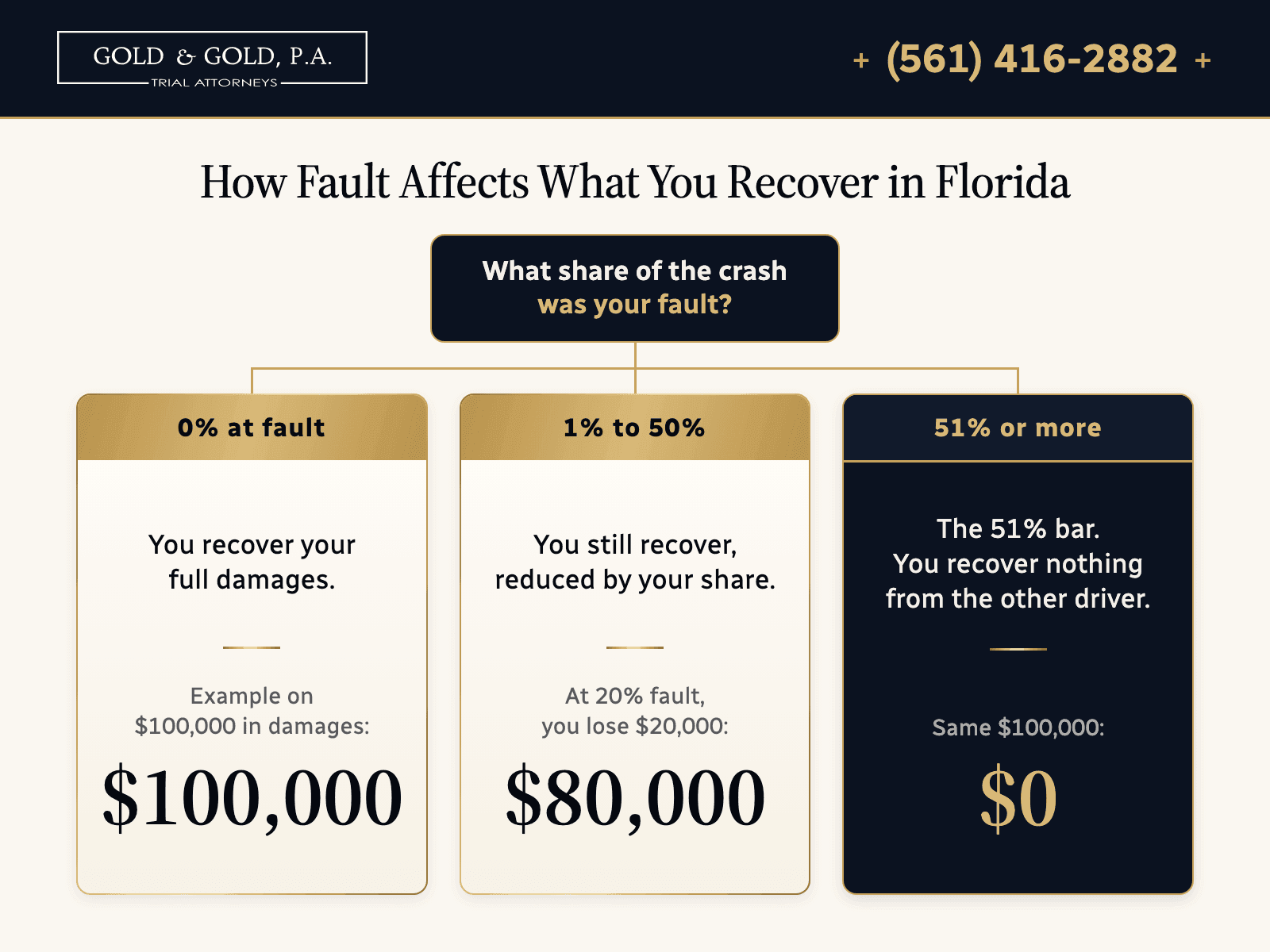
That is no longer true for most negligence claims that accrued on or after March 24, 2023. House Bill 837 changed Florida to modified comparative negligence. Here is how it works now:
- If you are 50% or less at fault, you can still recover, but your damages are generally reduced by your share. At 30% fault on a $100,000 damages award, you could recover $70,000.
- If you are more than 50% at fault, you generally cannot recover damages from another party whose negligence contributed to your injury. This is commonly called the 51% bar.
That 1 percent difference, from 50 to 51, is the line between a reduced recovery and zero. It is why insurance companies may work aggressively to assign an injured person a majority of the fault. Every percentage point can reduce the claim’s value, and crossing the 50% threshold can bar recovery entirely.
At Gold & Gold, P.A., we evaluate fault percentages carefully because an insurer’s initial assessment may not reflect all of the available evidence or Florida law.
How Fault Is Proven
Fault is not decided by who sounds more convincing. It is decided by evidence. The stronger and earlier the evidence, the better your position.
The Evidence That Matters Most
- The police report. The responding officer's notes and any citations carry real weight.
- Photos and video. Scene photos, dashcam footage, and nearby security cameras.
- Witness statements. Neutral people who saw the crash are powerful.
- Physical evidence. Skid marks, debris, and vehicle damage tell a story.
- Expert analysis. In serious cases, a crash reconstruction expert can map out what happened.
Much of this evidence fades fast. Cameras record over old footage, skid marks wash away, vehicles are repaired or destroyed, and memories blur. Acting quickly preserves the proof that may ultimately determine fault.
Who Actually Decides Fault?
Fault is not final just because the other insurer says so. In practice, police officers, insurance companies, and attorneys may each form their own opinions about responsibility, but those opinions serve different purposes.
An officer may issue a citation or describe contributing factors in a crash report. An insurance adjuster may assign percentages of fault when evaluating a claim. Neither assessment is necessarily the final legal determination.
If the case goes to court, the fact-finder, typically a jury, determines negligence, causation, and each party’s percentage of fault based on the admissible evidence and the judge’s instructions.
At Gold & Gold, P.A., we do not assume an insurer’s fault assessment is correct. We examine the evidence independently and challenge conclusions that are incomplete, unsupported, or inconsistent with the facts.
How to Protect Yourself From Unfair Blame
Because a majority of fault now means a potential complete bar to recovery, protecting yourself from unfair blame is particularly important. A few habits help:
- Never admit fault or apologize at the scene
- Photograph everything before cars are moved, if it is safe
- Get names and numbers of any witnesses
- Be careful with recorded statements to insurers
- Get legal advice early if any fault is being pushed onto you
Frequently Asked Questions
Can more than one driver be at fault?
What happens if I am found mostly at fault?
Does a police report decide who is at fault?
Is Florida a no-fault state? Then why does fault matter?
How is fault decided in a rear-end crash?
Protecting Your Rights When Fault Is Disputed
Fault in a Florida crash is a legal judgment built on evidence, and it is now more consequential than ever. Because being more than half at fault may bar recovery entirely, every percentage point matters, and insurers know it.
If fault is disputed, or if the other side is trying to shift the blame onto you, do not accept an insurer’s assessment without understanding the evidence behind it. A lawyer can gather time-sensitive evidence, interview witnesses, review vehicle and roadway data, consult appropriate experts, and challenge an unsupported fault determination.
At Gold & Gold, P.A., we help injured people understand how Florida’s fault rules apply to the specific facts of their accidents. We investigate how the crash happened, identify every potentially responsible party, and work to prevent insurers from reducing or denying valid claims through unfair blame.
Being blamed for a crash you did not cause is stressful and can feel personal. You do not have to sort it out alone, and the sooner someone starts protecting your side of the story, the stronger it stays. If you were injured in a Florida auto accident and fault is unclear or disputed, contact Gold & Gold, P.A., for a free case evaluation. We will review the available evidence, explain how comparative negligence may affect your claim, and help you understand your legal options.
Injured and unsure of your next step?
Speak with a trial attorney today. Free, confidential, and no fee unless we win.