
Putting a dollar amount on pain and suffering damages can be difficult for juries. It is also one of the most important questions in many Florida auto accident cases because, for people who have suffered serious injuries, pain and suffering is often the largest component of a settlement or verdict. The math is not formulaic. It is also not random. Florida lawyers use two primary methods to estimate pain and suffering damages, both of which create starting points that are refined through negotiation, evidence, medical documentation, and the overall strength of the case.
This article explains what pain and suffering legally means in Florida, who qualifies to recover for it, the two primary calculation methods with examples, what affects the final number, and how insurance companies evaluate these claims behind the scenes.
At Gold & Gold, P.A., we regularly help injured clients understand how non-economic damages fit into the overall value of a Florida car accident claim.
What Is Pain and Suffering in a Florida Auto Accident?
Pain and suffering is the legal term for non-economic damages: harms from an accident that do not appear on a bill but that Florida law recognizes as compensable. While medical bills and lost wages are calculated from receipts and pay stubs, pain and suffering measures the human cost of an injury. Florida law allows recovery for:
- Physical pain during the accident, the recovery period, and ongoing if the injury is permanent
- Emotional distress and mental anguish, including anxiety, depression, and post-traumatic stress
- Loss of enjoyment of life, meaning activities, hobbies, and relationships you can no longer participate in the way you used to
- Inconvenience and embarrassment in some cases, particularly with visible injuries or disfigurement
- Loss of consortium, which is a separate claim a spouse can bring for the impact of the injury on the marital relationship
Pain and suffering is calculated separately from economic damages such as medical bills, lost wages, and property damage. The categories are then combined to determine the total value of a claim.
Can You Always Recover Pain and Suffering in Florida? The Serious Injury Threshold
Not necessarily. Florida's no-fault system limits when an injured person can recover pain and suffering damages from the at-fault driver. To pursue these damages, your injuries generally must meet Florida's serious injury threshold under Florida Statute section 627.737.
The threshold includes four categories. You only need to meet one:
- Significant and permanent loss of an important bodily function. Walking, gripping, seeing, hearing, lifting. If something your body used to do is significantly and permanently impaired, this category applies.
- Permanent injury within a reasonable degree of medical probability. A doctor confirms that the injury is permanent, not just painful right now. This is the most common qualifier and the one insurers fight hardest.
- Significant and permanent scarring or disfigurement. Visible, lasting changes to appearance. Scars from lacerations, surgical scars from accident-related procedures, or other disfigurement.
- Death. Wrongful death cases proceed under separate rules but qualify outside the no-fault limitation.
If your injury fits none of these categories, Florida's no-fault law generally limits you to economic damages paid through your own PIP coverage, up to the $10,000 PIP limit. You cannot pursue pain and suffering against the at-fault driver. This is the entire point of the threshold, and it is why a minor fender-bender with no lasting injury does not produce a meaningful pain and suffering recovery, even if the experience was frightening.
The threshold is also why consistent medical care and a clear permanency opinion from your doctor matter so much. Soft-tissue injuries can meet the threshold when properly documented; serious-looking injuries can fall short of it when documentation is inconsistent. At Gold & Gold, P.A., one of the first questions we evaluate is whether the medical evidence supports a finding of permanency. In many cases, that determination has a direct impact on whether pain and suffering damages are recoverable at all.
The Two Methods Florida Lawyers Use to Calculate Pain and Suffering
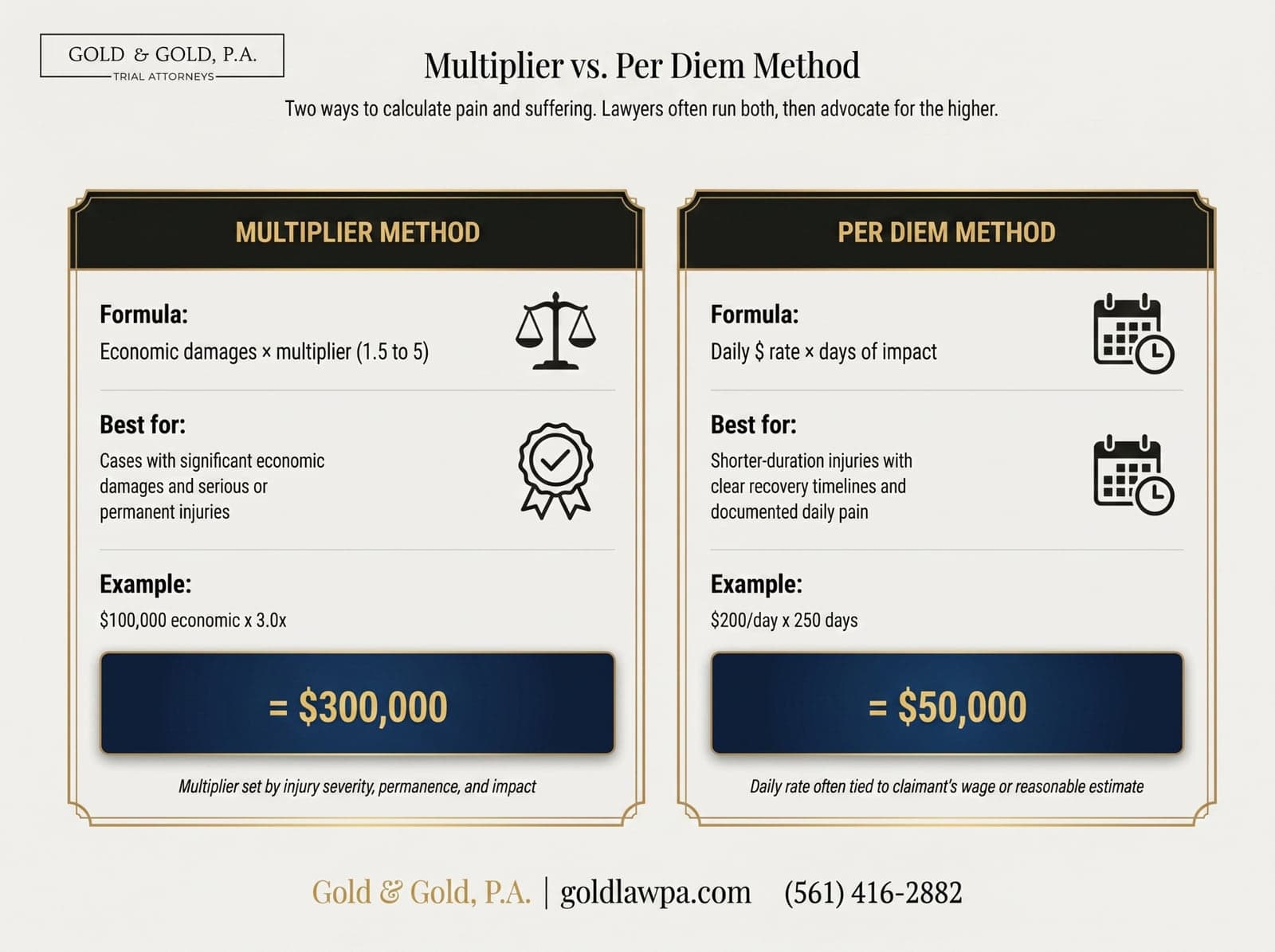
Once your injury meets the serious injury threshold, the next question is how much your pain and suffering is worth. Lawyers use two main methods. Many attorneys evaluate pain and suffering using both approaches, then compare the results against jury verdicts, settlement trends, and the specific facts of the case. Insurers do the same in reverse. The final negotiated number lands somewhere between.
The Multiplier Method
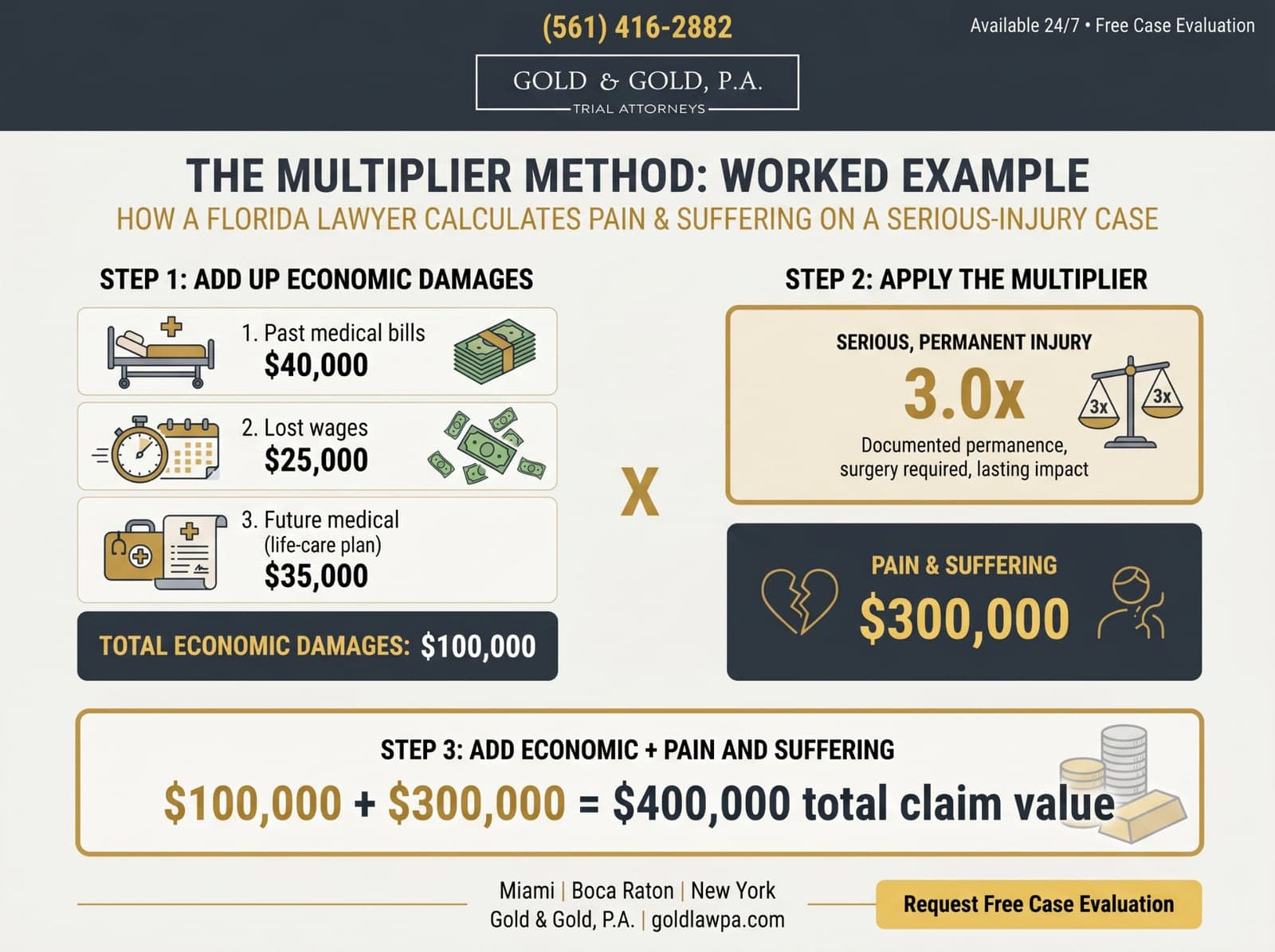
The multiplier method is the more common of the two. Total economic damages are multiplied by a factor, typically between 1.5 and 5, based on the severity and permanence of the injuries.
Worked example: A Florida claimant has $40,000 in past medical bills, $25,000 in lost wages, and $35,000 in projected future medical needs documented in a life-care plan. Total economic damages equal $100,000. The injuries are serious, surgery was required, and a doctor has documented permanence. A 3.0x multiplier produces $300,000 in pain and suffering, bringing total claim value to $400,000.
What moves the multiplier:
| Injury Category | Typical Multiplier | Why |
|---|---|---|
| Soft tissue, full recovery | 1.5 to 2.0 | Pain real but resolves |
| Moderate injury, treatment required | 2.0 to 3.0 | Sustained recovery period |
| Serious injury, documented permanence | 3.0 to 4.0 | Lasting impact on daily life |
| Catastrophic, life-altering disability | 4.0 to 5.0+ | Permanent loss of function |
These are typical ranges, not fixed rules. A young claimant with permanent injuries might warrant a multiplier above the typical range. An older claimant with the same injuries might warrant something below it because the documented lifetime impact is shorter. The multiplier is not determined by a fixed formula. It is supported by medical evidence, permanency findings, life impact evidence, and the attorney's ability to demonstrate the full extent of the injury.
The Per Diem Method
The per diem method assigns a daily dollar amount to pain and suffering, then multiplies it by the number of days the injury affected the claimant.
Worked example: A claimant assigns $200 per day, based on her daily wage as a starting point, for 250 days of significant pain and limited function during recovery. Total pain and suffering = $50,000.
Where the daily figure comes from:
- Sometimes the claimant's daily wage. The argument: a day of suffering is worth at least a day of work.
- Sometimes a reasonable figure based on the severity of daily pain and how it disrupted the claimant's life.
- Insurance companies frequently challenge per diem calculations because the daily amount and duration are often subjective and open to debate.
Per diem works better than the multiplier method for cases with shorter-duration injuries, clear recovery timelines, low economic damages but significant prolonged pain, or claimants with unusual earning capacity (very high or very low) that distorts the multiplier math.
Which Method Wins?
Neither method controls the outcome by itself. The multiplier method and per diem method are simply tools for valuing non-economic damages. Ultimately, settlements are driven by the strength of the evidence, the severity of the injury, available insurance coverage, comparable verdicts, and the willingness of both sides to proceed to trial if necessary.
At Gold & Gold, P.A., we use these calculations as part of a broader case valuation process rather than relying on any single formula.
What Affects How Much Pain and Suffering Is Worth
Beyond the calculation method, several real-world factors move the final number up or down. The multiplier (or daily rate) is not chosen arbitrarily; it is justified by these factors. Insurance companies, lawyers, mediators, and juries all evaluate these factors when determining the value of pain and suffering damages.
- Severity of the injury. The single biggest driver. A herniated disc with surgery and lasting limitation is in a different category from a strained muscle that resolves in three months.
- Permanence. Temporary injuries that fully heal are worth less than permanent injuries that affect the rest of the claimant's life. Permanence opens the higher multipliers.
- Visible versus invisible injuries. Scarring, amputation, and obvious disfigurement tend to settle higher because juries see the impact directly. Conditions such as chronic pain, nerve injuries, and traumatic brain injuries may require stronger medical documentation because their effects are not always immediately visible.
- Age of the claimant. Younger claimants carry more pain and suffering value because they will live with the injury longer. A 35-year-old with a permanent back injury has roughly 40 more years of impact than an 80-year-old with the same injury.
- Pre-existing conditions. Insurers argue prior injuries reduce the value of current ones. The right answer is honest disclosure plus a treating doctor who can clearly distinguish what is new and accident-related from what existed before.
- Quality of life impact. What the claimant used to do, what they can no longer do, and what their daily life looks like now. Specific, vivid documentation moves numbers. Generic statements do not.
- Credibility of the claimant. Juries decide whether the claimant comes across as honest. Inconsistent stories, social media posts contradicting the claim, or exaggerated symptoms all destroy pain and suffering claims.
- Jurisdiction. Florida juries vary by county. Settlement values and jury verdicts can vary significantly by venue. Attorneys routinely consider local verdict trends and jury tendencies when evaluating a case.
How Insurers Actually Value Pain and Suffering
Understanding how insurance companies evaluate pain and suffering can help explain why settlement offers often differ from what injured people expect. Insurance companies use claims valuation software, the best known of which is Colossus, to process medical records, treatment codes, and case facts into a recommended settlement range. The software is heavily weighted toward economic damages and tends to undervalue pain and suffering systematically.
This is one reason early settlement offers can come in low. The software produces a conservative number, and the adjuster's job is to settle near that number, not at the case's actual value. Adjusters do not have unlimited authority to negotiate; their range is set by what the software produced plus a defined cushion.
Counter-offers backed by thorough medical documentation, life-care plans, comparable Florida verdicts, and a credible threat of trial are what move the negotiation toward the case's true value. This is one reason experienced personal injury attorneys focus heavily on documentation, expert opinions, comparable verdicts, and trial preparation. Insurance companies often evaluate claims differently when litigation is a realistic possibility.
How to Maximize Your Pain and Suffering Recovery
The factors above are not abstract. They translate to specific things claimants can do, and should not do, while their case develops. While there is no guaranteed way to increase the value of a claim, the following steps can help preserve and strengthen a pain and suffering claim.
- Document the impact, not just the injury. Beyond your medical records, keep a recovery journal. Pain levels by day, activities you could not do, sleep disruption, mood changes, family and social impacts. This kind of detail is what moves the multiplier.
- Get consistent medical care that documents pain and limitation. Doctors who note pain levels and functional limitations in their charts give your case the evidence pain and suffering claims need. Gaps in treatment, by contrast, are exactly what insurers use to argue your injuries were not serious.
- Be specific about what you have lost. Generic statements like 'I am in pain' do not move numbers. Specific losses do. 'I can no longer pick up my grandchildren,' 'I had to give up coaching my son's soccer team,' 'I have not slept through the night in eight months,' all carry weight. The more specific, the better.
- Be careful what you post on social media. Defense lawyers find every public post. A photo of you smiling at a barbecue or attending a wedding can be twisted into evidence that you are 'fine,' no matter how much pain you were actually in that day.
- Do not exaggerate. Adjusters and juries can spot it, and one overstated claim damages every honest claim in the same case. Honest, specific documentation is far more persuasive than dramatic claims.
- Hire a lawyer with trial experience. Pain and suffering damages are often one of the most heavily disputed components of a personal injury claim. Trial experience can become particularly important when negotiations stall and litigation becomes necessary. The threat of a jury seeing the full impact of an injury is what moves an insurer past their software's conservative number. A lawyer who has never tried a case has no credible threat to make.
Frequently Asked Questions
How is pain and suffering calculated in an auto accident?
How much is pain and suffering worth in an auto accident?
How do I prove pain and suffering after a car accident?
Can I get pain and suffering for a minor accident in Florida?
Is there a cap on pain and suffering damages in Florida?
How long does it take to settle a pain and suffering claim?
The Value of Pain and Suffering in a Florida Auto Accident Claim
Pain and suffering is real, recoverable in Florida cases that meet the serious injury threshold, and often the largest single piece of a serious-injury settlement. The multiplier and per diem methods provide useful starting points, but the final value of a claim depends on medical evidence, documentation, comparable verdicts, insurance coverage, negotiation, and the overall credibility of the case.
The practical step is simple: if you have been injured in a Florida auto accident and want to understand what your pain and suffering claim may be worth, a free consultation can provide a realistic evaluation based on your specific circumstances.
At Gold & Gold, P.A., we have handled Florida auto accident cases involving everything from threshold-qualifying soft-tissue injuries to catastrophic, life-changing injuries. If you would like to better understand the potential value of your claim, contact us for a free case evaluation. We will explain the factors that affect pain and suffering damages and help you understand your legal options.
Injured and unsure of your next step?
Speak with a trial attorney today. Free, confidential, and no fee unless we win.