
You think the crash was mostly the other driver's fault, but maybe not entirely. Perhaps you were going a little fast, or glanced down for a second. Now you are wondering: Can you still recover compensation if you were partially at fault for a Florida car accident? A lot of people assume that being even slightly at fault bars them from recovering, and they give up before they even start.
That assumption is wrong, and it can cost you. In Florida, you can still recover damages even if you were partly to blame, as long as you were 50% or less at fault. This guide explains exactly where that line is, how your payment is calculated, and why insurers try so hard to shift fault onto you. At Gold & Gold, P.A., we regularly help clients whose claims have been challenged because an insurance company tried to assign them more blame than the evidence supports. Understanding Florida's comparative negligence law is often the first step toward protecting the value of a claim.
The Short Answer
Yes, you can still recover, as long as you were 50% or less responsible for the accident. Florida uses a rule called modified comparative negligence, codified in Florida Statute § 768.81. Your compensation is reduced by your share of the fault. But if you are found more than 50% at fault, you generally cannot recover anything from the other driver. That cutoff at 51% is often called the 51% bar, and it is one of the most significant changes made by Florida's 2023 tort reform law.
How Partial Fault Works in Florida
Since House Bill 837 became law in 2023, Florida follows modified comparative negligence. The rule has two simple halves:
- At 50% fault or less, you recover, but your award is reduced by your percentage of fault.
- At 51% fault or more, you generally cannot recover damages from the other party.
Think of it as a wall at the halfway mark. As long as you stay on the right side of it, you get compensated, just less. Cross it, and the door closes. That single percentage point, from 50 to 51, is the whole game. At Gold & Gold, P.A., we often remind clients that a relatively small shift in fault percentage can dramatically affect the outcome of a case.
A Quick Note on What Changed
Florida used to follow pure comparative negligence, which allowed injured people to recover damages even if they were primarily responsible for an accident.
That changed for most negligence claims arising on or after March 24, 2023, when House Bill 837 introduced modified comparative negligence. Now, being more than 50% at fault generally prevents recovery altogether, making fault allocation more important than ever before.
The Math: How Your Payment Is Calculated
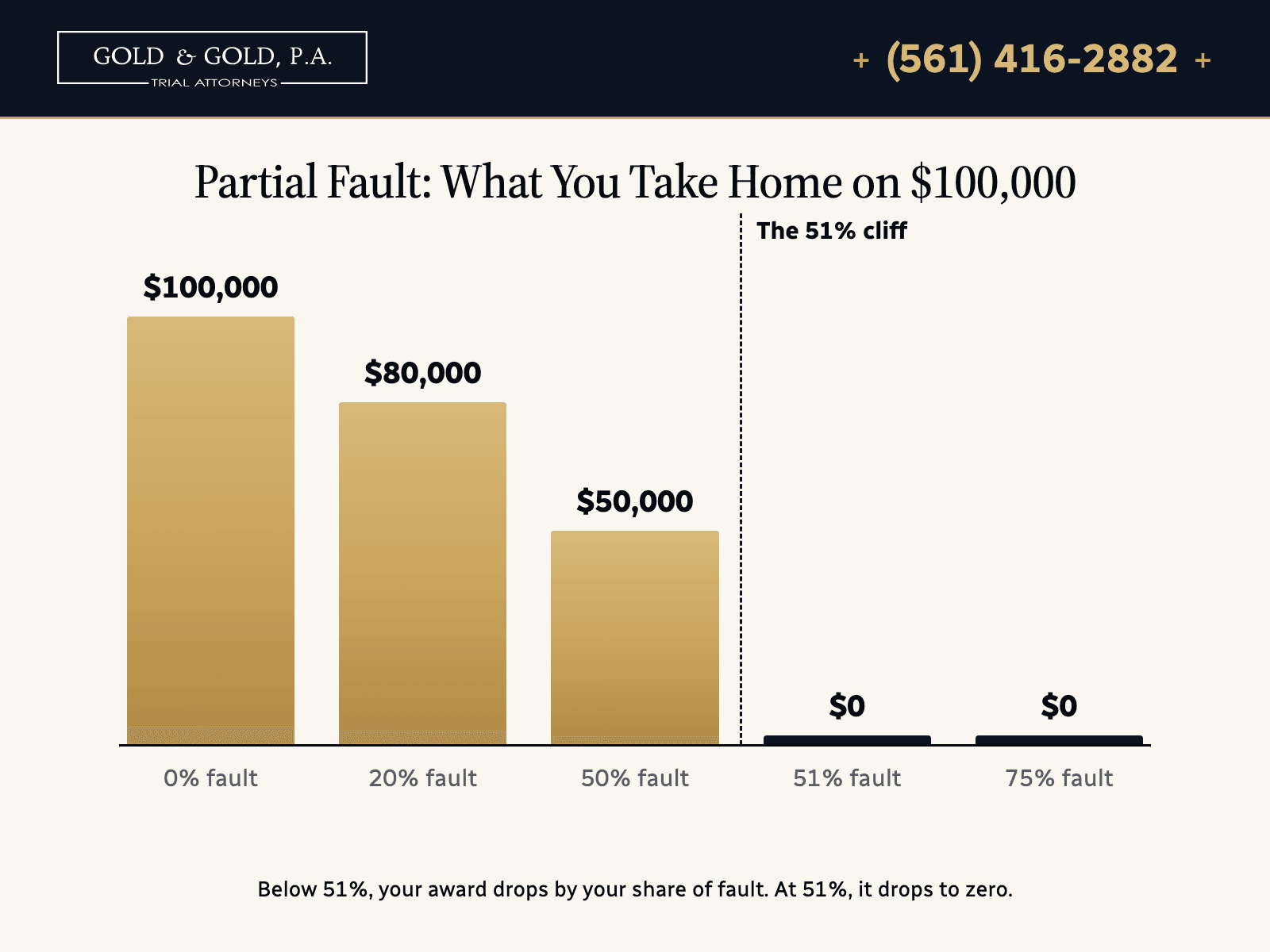
The calculation itself is straightforward. Take your total damages, then subtract your share of fault. Here is how it plays out on a $100,000 claim.
| Your Share of Fault | What You Recover | What You Lose |
|---|---|---|
| 0% | $100,000 | $0 |
| 10% | $90,000 | $10,000 |
| 25% | $75,000 | $25,000 |
| 50% | $50,000 | $50,000 |
| 51% | $0 | Everything |
| 75% | $0 | Everything |
Illustration only, based on Florida's modified comparative negligence rule. Actual damages vary by case.
Because every percentage point matters, accurately determining fault can significantly affect the value of your claim. At Gold & Gold, P.A., we frequently review police reports, witness statements, photographs, surveillance footage, and accident reconstruction evidence to challenge unfair fault assessments.
Look at the jump between 50 and 51%. At 50%, you still take home $50,000. At 51%, you take home nothing. Nowhere else on the scale does one percentage point matter that much. This is the exact spot where fault fights are won and lost.
Why Insurance Companies Push Fault Onto You
Once you understand the 51% bar, the insurance company's behavior makes sense. Every percentage of fault they can assign to you cuts what they owe. If they can successfully argue that you were more than 50% responsible, they may avoid paying your claim altogether.
That is why disputes over fault are common, even when liability initially appears straightforward. So expect the other driver's insurer to look for any way to blame you. Common tactics include:
- Arguing you were speeding, distracted, or could have avoided the crash
- Using your own words from a recorded statement against you
- Leaning on an early, lopsided fault estimate from an adjuster
- Pointing to social media posts to question your version or your injuries
None of this means they are right. It means fault is contested, and contested fault is something you can push back on with evidence.
How to Protect Your Recovery
Because even a small change in fault allocation can significantly affect your recovery, taking the following steps can help protect your claim:
- Do not admit fault. Not at the scene, not to the other insurer. Let evidence decide, not a stressed apology.
- Preserve the evidence. Scene photos, dashcam or security footage, and witness contacts. This is what rebuts an unfair fault claim.
- Be careful with statements. You are not required to give the other driver's insurer a recorded statement. Early guesses get locked in.
- Get a fault finding reviewed. An adjuster's fault split is an opinion, not a verdict. It can be challenged.
- Talk to a lawyer if fault is disputed. The closer your case is to the 51% line, the more a professional pushing back matters.
If liability is disputed, an experienced Florida auto accident lawyer can often identify evidence that was overlooked during the insurance company's initial investigation.
What Damages You Can Still Recover
As long as you stay at or below 50% fault, you may still be able to recover the same categories of damages available in other Florida personal injury claims, including:
- Medical expenses. Past and future treatment costs.
- Lost wages. Income lost now and earning ability lost going forward.
- Pain and suffering. The physical and emotional toll, if your injury meets Florida's serious injury threshold.
- Property damage. Repairs or replacement of your vehicle.
Each category of damages is reduced by your percentage of fault rather than eliminated altogether.
Frequently Asked Questions
Can I recover if I was 50% at fault?
Who decides my percentage of fault?
Does this rule apply to all accident cases?
What if the other side blames me unfairly?
Did this rule use to be different?
Understanding Florida's Comparative Negligence Rule
Being partly at fault does not mean walking away empty-handed. Under Florida's modified comparative negligence law, you may still recover compensation as long as you are not found to be more than 50% responsible for the accident. Your recovery is simply reduced by your share of fault.
Because even a small change in fault percentage can significantly affect the outcome of a case, insurance companies often work aggressively to shift blame onto injured people.
At Gold & Gold, P.A., we understand how important these fault determinations can be. If an insurance company is trying to place more blame on you than the evidence supports, we can investigate the accident, challenge inaccurate fault assessments, and help protect your right to recover compensation.
If you are unsure whether your own actions affect your ability to recover damages, a free consultation can help you understand your rights under Florida law and the options available based on the facts of your case.
Injured and unsure of your next step?
Speak with a trial attorney today. Free, confidential, and no fee unless we win.