
If you have been hurt in a Florida auto accident, the question on your mind is some version of: what is my car accident case worth? You will not get a precise answer in this article, and you should be skeptical of any article that claims to give you one. What you will get is a realistic look at settlement ranges by injury severity, the factors that drive settlement value up or down, and a clear picture of how an auto accident settlement is actually calculated in Florida.
Florida settlements vary widely. A minor soft-tissue injury and a catastrophic crash with permanent disability are not in the same conversation. The difference between the two is not luck. It is the medical picture, the evidence, the insurance coverage available, and the lawyer doing the work. Each of those is something you can either influence or understand.
At Gold & Gold, P.A., we have handled Florida auto accident cases at every level of severity, from soft-tissue claims resolved in months to complex cases involving permanent injuries and multi-million-dollar outcomes. The patterns in this article come from that experience.
What is the Average Settlement for an Auto Accident in Florida?
Honestly, there is no useful average. The spread is too wide for one number to mean anything. A blanket figure that mixes a $5,000 fender-bender claim with a $10 million catastrophic verdict produces a number that describes no actual case. What the data does support is general settlement ranges by injury severity, which is the most useful frame for understanding where your case might fit.
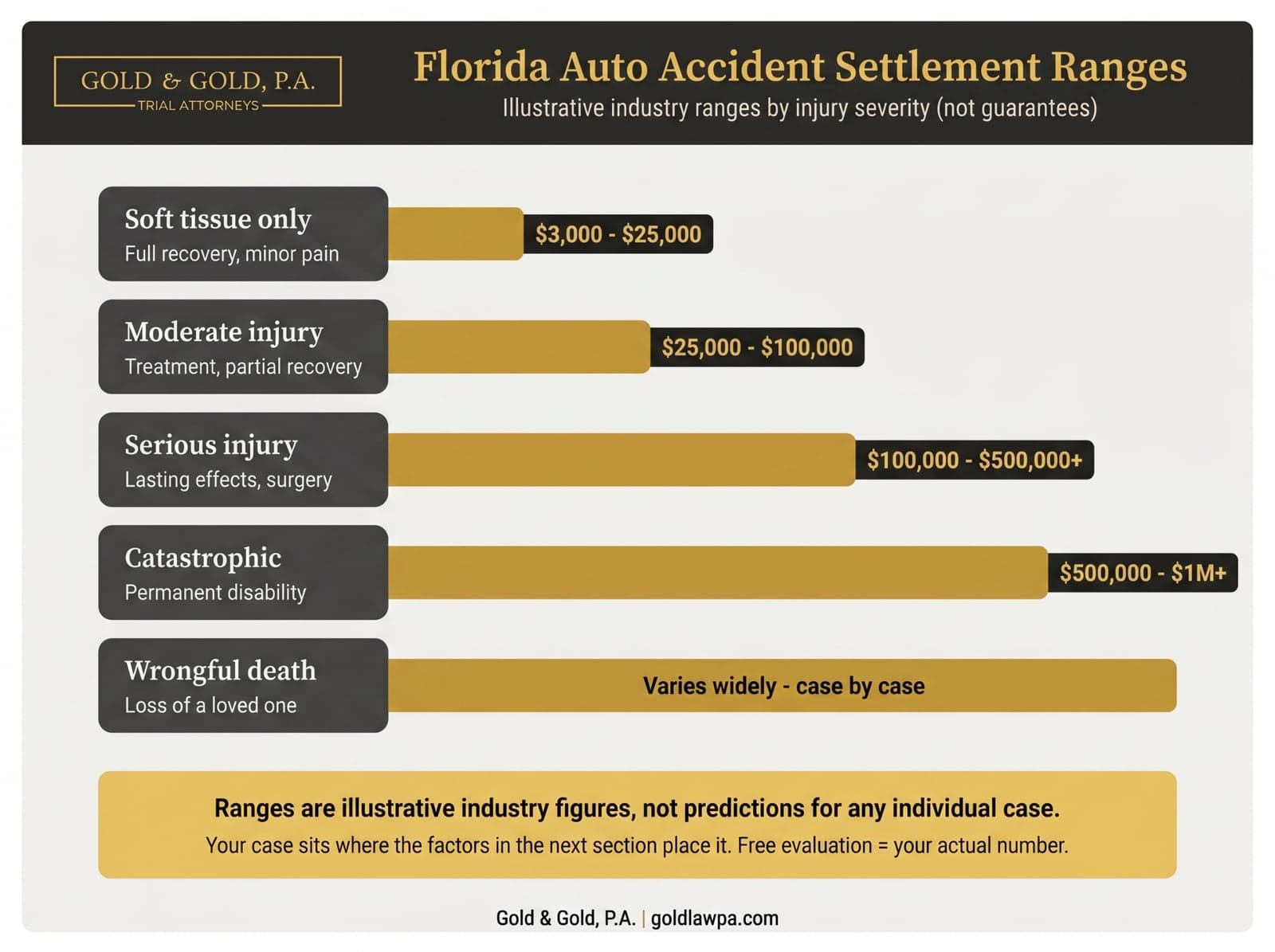
| Injury Severity | Illustrative Settlement Range |
|---|---|
| Soft tissue, full recovery | $3,000 to $25,000 |
| Moderate injury, treatment required | $25,000 to $100,000 |
| Serious injury, lasting effects | $100,000 to $500,000 or more |
| Catastrophic or permanent disability | $500,000 to $1 million or higher |
| Wrongful death | Varies widely; case-by-case |
These ranges are illustrative industry figures, not predictions for any individual case. Your case sits where the factors in the next section place it. The fastest way to get a realistic range for your specific situation is to speak with an experienced Florida auto accident attorney.
What Affects How Much Your Auto Accident Settlement is Worth
Settlements are calculations, not guesses. A lawyer values a case by working through the same set of factors every time, then comparing the result against verdict ranges for similar cases. These are the factors that matter most.
- Severity and permanence of the injury. The biggest single driver of settlement value. Permanent injuries, surgeries, ongoing disability, and long-term care needs all push the number up significantly. A soft-tissue injury that fully resolves in three months and a permanent spinal injury are not in the same category.
- Medical bills and future medical needs. Past bills set the floor. Future medical needs, often projected by a life care planner or medical expert, are where serious cases multiply. A case with $15,000 in past bills and $300,000 in projected future care is valued very differently than one with $15,000 and nothing forward-looking.
- Lost wages and lost earning capacity. These are two separate categories. Lost wages are what you could not earn during recovery. Lost earning capacity is what your career took as a long-term hit, including reduced ability to work in your trained field, lost promotions, or having to switch to lower-paying work. Lost earning capacity is often the bigger number and the one most often undervalued by claimants negotiating on their own.
- Pain and suffering. Florida allows recovery for non-economic damages: physical pain, emotional distress, loss of enjoyment of life, disfigurement, mental anguish. For cases with permanent injuries, pain and suffering can equal or exceed the economic damages. The next section covers how it is calculated, and our companion article on how pain and suffering is calculated walks through the math in more detail.
- Fault clarity. Florida is now a modified comparative negligence state. If you are found more than 50 percent at fault, you recover nothing. Even if you are 25 percent at fault, your recovery is reduced by 25 percent. Disputed fault drops settlement value at every percentage point, which is why insurers fight hard to assign you a share of the blame even when you were not the cause. At Gold & Gold, P.A., we often see settlement value affected not only by what happened in the crash, but by how clearly the evidence proves it. That is why early investigation matters.
- PIP coverage and the serious injury threshold. Florida's no-fault system caps your own PIP coverage at $10,000. To step outside no-fault and pursue the at-fault driver for the full value of your damages, your injuries must meet the serious injury threshold: permanent loss of a body function, permanent injury within a reasonable degree of medical probability, significant scarring, or death. Cases that do not meet the threshold are limited.
- Policy limits. The at-fault driver's insurance maximum. This is often the practical ceiling on your recovery, regardless of how strong your case is or how severe your injuries were. Florida does not require most drivers to carry bodily injury liability coverage at all, so a meaningful number of at-fault drivers have no bodily injury coverage to pay from. See the policy limits section below for what to do about this.
- Strength of evidence. Police report, witness statements, traffic camera footage, vehicle damage photos, complete and consistent medical records. Strong evidence drives settlements up because insurers know what a jury would see if the case went to trial. Weak or inconsistent evidence drives settlements down for the same reason.
- Quality of legal representation. Insurers track lawyers and firms. Cases handled by trial-tested firms settle higher because the insurer knows the alternative is a courtroom, and the lawyer across the table has been there before. This is not marketing language; it is a documented pattern in claims data.
How Pain and Suffering is Calculated in a Florida Auto Accident
Pain and suffering is recovered as non-economic damages. Florida does not have a strict statutory cap on most auto accident non-economic damages, but the amount has to be reasonable in relation to the documented injuries and the economic damages claimed.
Two methods are used in practice:
- Multiplier method. Total economic damages (medical bills, lost wages, future medical) are multiplied by a factor, typically between 1.5 and 5, depending on the severity and permanence of the injuries. A case with $50,000 in economic damages and a 3x multiplier yields $150,000 in pain and suffering.
- Per diem method. A daily dollar amount is assigned to the pain and suffering, then multiplied by the number of days the injury affected the person. A daily figure of $150 over a 200-day recovery yields $30,000.
Both methods are starting points for negotiation, not formulas an insurer will accept without pushback. For a deeper walk-through of how pain and suffering is calculated in Florida auto accident cases, see our companion article on the topic.
Florida Policy Limits and Why They Cap Most Settlements
People searching how often auto accident settlements exceed the policy limits hope the answer is more often than it actually is. The honest answer: rarely, and only under specific circumstances.
Florida requires drivers to carry only $10,000 in Personal Injury Protection (PIP) and $10,000 in Property Damage Liability (PDL). Florida does not require most drivers to carry bodily injury liability coverage at all. This means some at-fault drivers in Florida have no bodily injury coverage available, and the practical ceiling on your recovery may be whatever coverage actually exists.
Settlements can exceed the at-fault driver's policy limits in a few situations:
- Bad faith claims against the insurer. If an insurer refuses a reasonable settlement opportunity within policy limits and the case later results in a verdict above those limits, the insurer may be exposed to more than the policy maximum. Bad faith litigation is complex but can sometimes be the difference between recovering policy limits and recovering fuller case value.
- Multiple policies stacked. Employer coverage if the at-fault driver was working, umbrella policies, commercial coverage, and uninsured or underinsured motorist coverage from your own policy can all add up. A serious case may involve several potential sources of recovery.
- Personal assets of the at-fault driver. This is rare in practice, but possible. Most at-fault drivers do not have meaningful collectible assets beyond insurance. In high-asset cases, this may be worth evaluating.
- Commercial vehicle policies. Trucking companies, rideshare platforms, and other commercial defendants may carry higher insurance limits. Commercial vehicle cases are often valued differently because the available coverage can be much higher.
At Gold & Gold, P.A., one of the first things we look for in serious auto accident cases is every available source of insurance coverage. The value of a case depends not only on the injury, but also on where recovery can realistically come from. The most important takeaway here is uninsured and underinsured motorist coverage on your own policy. Florida does not require it, but it is often the most practical protection against being hit by a driver with little or no bodily injury coverage. Many attorneys recommend carrying meaningful UM/UIM coverage if you can afford it.
How Long Do Auto Accident Settlements Take in Florida?
| Stage | Typical Duration |
|---|---|
| Demand letter sent to insurer's response | 4 to 8 weeks |
| Pre-suit negotiation | 1 to 6 months |
| Lawsuit filed through resolution | 12 to 24 months |
| Complex or catastrophic cases | 18 months to several years |
Settling fast is almost always settling low. The insurer's first offer is rarely a fair offer. The cases that resolve in 4 to 8 weeks resolve that quickly because someone accepted a number before they fully understood what their injuries would require long-term.
Settlements that reflect full value take time because they require complete medical documentation, accurately calculated future costs, and a credible threat of trial. The earlier a lawyer is involved, the more of that time gets used productively.
How to Maximize the Value of Your Auto Accident Settlement
If you are searching how to get the most money from an auto accident, the honest answer is a combination of patience, documentation, and representation. These steps are the ones that consistently produce the highest settlements relative to case strength.
- Get medical care immediately and follow through. Gaps in treatment hurt cases. Florida's 14-day PIP rule is the floor; consistent follow-up care that documents your recovery is the structure. Missed appointments and untreated symptoms are exactly what insurers use to argue your injuries were not serious.
- Document everything. Photos of the scene, photos of injuries, bills, prescriptions, missed work days, activities you can no longer do, and significant mood or sleep changes can all matter. More documentation is almost always better than less.
- Do not give a recorded statement to the at-fault insurer without a lawyer. In many situations, you are not required to give a recorded statement to the other driver's insurer before speaking with an attorney. Adjusters use recorded statements to look for inconsistencies later, even small ones.
- Do not accept the first offer. First offers are often anchored low. The insurer expects negotiation. Counteroffers and additional documentation can significantly affect the final settlement number.
- Hire a lawyer with trial experience. Insurers respond differently when the lawyer across the table is prepared to try the case. Track record matters.
- Let the case develop before settling. Some injuries fully reveal themselves over 6 to 12 months. Settling too early may mean accepting a number based on incomplete information.
- Be honest with your lawyer about everything. Past injuries, prior claims, pre-existing conditions, and the full medical picture all need to be disclosed. Surprises can damage cases when the insurer's lawyer finds them later. Disclosed early, they are manageable.
At Gold & Gold, P.A., we help clients avoid the common mistakes that reduce settlement value, from treatment gaps and premature settlements to incomplete documentation and avoidable insurance statements.
How Do Auto Accident Settlements Work? The Process
From the moment your accident happens to the moment a check arrives, the path looks something like this:
- Medical treatment progresses. You get care, the records build, and your lawyer monitors the medical picture as it develops. Settlement value cannot be calculated until the medical situation is reasonably stable.
- Your lawyer values the case. Based on the documented damages, future projected costs, comparable verdicts, and the strength of the evidence, your lawyer calculates a target settlement range and a floor.
- Demand letter to the insurer. A formal demand lays out the facts, the injuries, the damages, and what it would take to settle. This begins the negotiation process.
- Negotiation rounds. Most cases involve several rounds of negotiation, counteroffers, additional documentation, and pressure from both sides. Many cases settle here.
- Lawsuit filed if needed. If pre-suit negotiation does not produce a fair number, your lawyer may file a lawsuit. This stops the two-year statute of limitations clock and moves the case into discovery, mediation, and potentially trial. Our companion article on the auto accident lawsuit process covers this in more detail.
- Settlement and disbursement. Once a settlement is reached, the check is issued to the law firm. Medical liens and case costs are paid out, attorney fees are deducted, and the remainder goes to you. A full disbursement statement breaks down every dollar.
Frequently Asked Questions
How much is my auto accident worth?
How much should I receive from my auto accident?
What is a fair settlement for an auto accident?
Can you negotiate an auto accident settlement on your own?
How much can I sue for in an auto accident in Florida?
What am I entitled to in an auto accident?
Understanding What Your Florida Auto Accident Settlement May Be Worth
There is no single typical number for a Florida auto accident settlement. There is a number for your case, and getting it right requires honest evaluation of the medical picture, the evidence, the available insurance coverage, and comparable outcomes in similar cases.
The practical step is straightforward: a free consultation with a Florida auto accident attorney costs nothing and gives you a realistic range for your specific situation. A lawyer can explain where your case likely sits on the spectrum, what factors could push it higher or lower, and what timeline to expect.
At Gold & Gold, P.A., we have secured Florida auto accident verdicts and settlements across the full range of severity, from minor injury cases to serious and catastrophic claims. If you were injured in a Florida auto accident and want to understand what your case may be worth, schedule a free case evaluation. We will walk you through the calculation honestly and help you understand your options.
Injured and unsure of your next step?
Speak with a trial attorney today. Free, confidential, and no fee unless we win.