
You were hurt in a crash, and now the bills are coming. You have heard that Florida is a no-fault state, which sounds like your insurance will just take care of things. Then you look at your policy and get confused. What does no-fault actually cover? And why do people say it is not enough? The honest answer is that Florida's no-fault system covers some of your initial accident-related losses, up to a point, and then it stops. Knowing where that line is can be the difference between getting the compensation available to you and getting stuck with bills. This guide breaks down Florida Personal Injury Protection coverage, its limits, and when you may be able to pursue the at-fault driver in plain terms.
At Gold & Gold, P.A., we regularly speak with injured people who assume PIP will cover all of their medical expenses. Understanding what no-fault insurance does and does not pay is an important first step in evaluating a Florida auto accident claim.
The Short Answer
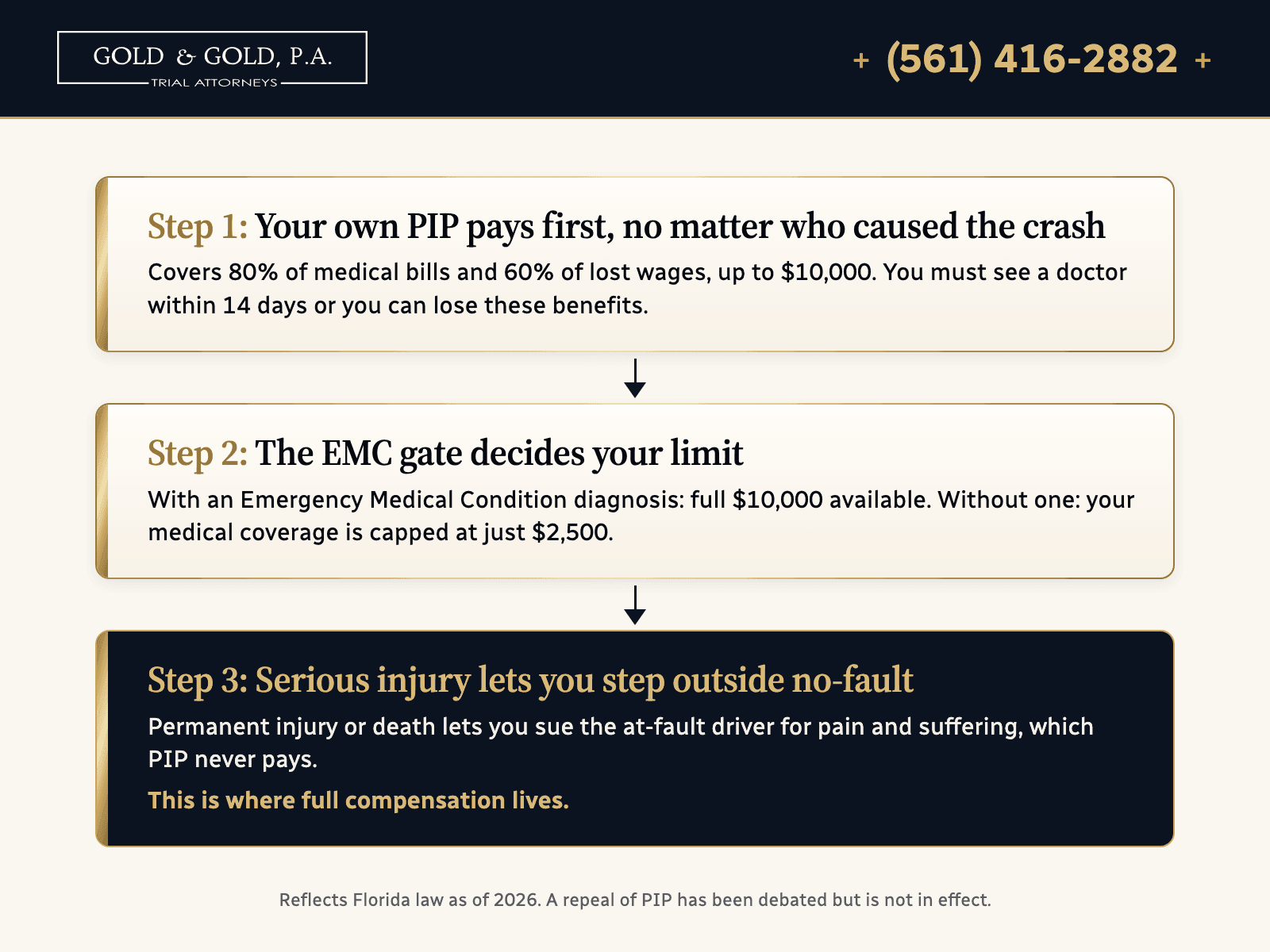
Yes, but only partly. Florida's no-fault system pays a portion of your initial medical expenses and lost income through Personal Injury Protection, or PIP, regardless of who caused the crash. But standard PIP benefits are generally limited to a combined total of $10,000 for medical and disability benefits. PIP typically pays 80% of reasonable and necessary medical expenses and 60% of qualifying lost income. It does not compensate you for pain and suffering. For a serious injury, the available benefits can be exhausted quickly.
What No-Fault Actually Means
No-fault does not mean no one is at fault. It means that after a crash, you generally turn to your own insurance first for your initial medical bills and certain lost-income benefits, instead of waiting for a determination of liability before receiving those benefits.
The idea, going back to the 1970s, was to speed up payments for minor injuries and keep small cases out of court. Every Florida vehicle owner required to maintain no-fault coverage generally must carry at least $10,000 in PIP coverage. When you are hurt, your PIP pays first, regardless of fault, subject to the terms, exclusions, deductibles, and limits of your policy.
Here is the part that trips people up: no-fault is only the starting point. It handles a limited portion of certain initial losses. For more serious injuries and damages that PIP does not cover, fault comes back into the picture, and a separate set of rules takes over.
What PIP Covers, and What It Does Not
PIP is useful, but it is narrow. Knowing its limits early can help you anticipate uncovered expenses and identify other potential sources of compensation.
| What PIP Covers | What PIP Does NOT Cover |
|---|---|
| 80% of reasonable, necessary, and covered medical expenses, subject to applicable benefit limits | The remaining 20% of your medical bills |
| 60% of qualifying lost gross income and loss of earning capacity, within the same combined benefit limit | Medical expenses, lost income, or replacement-service costs exceeding the available PIP benefits |
| A $5,000 death benefit in addition to medical and disability benefits | Pain and suffering or emotional distress |
| Coverage for the policyholder and, in qualifying circumstances, resident relatives, certain passengers, and certain pedestrians | Damage to your vehicle, which requires separate property coverage or a claim against an at-fault party |
Reflects Florida PIP rules under Florida Statute § 627.736 as of 2026.
These provisions reflect Florida's PIP requirements under Florida Statute § 627.736. The exact coverage available may also depend on your policy, deductible, the injured person's relationship to the policyholder, and whether another PIP policy applies. Notice what is missing: pain and suffering. PIP pays for limited medical, disability, and death benefits. The physical pain, the sleepless nights, the things you can no longer do, none of that is covered by no-fault benefits themselves. For many seriously injured people, those non-economic losses represent a substantial part of the harm caused by the crash.
At Gold & Gold, P.A., we review both the PIP claim and the broader liability claim because they involve different coverages, different damages, and different legal requirements.
Two Catches That Can Shrink Your Coverage
Even the coverage you have can be reduced or lost if you are not careful. Two rules can catch people off guard.
The 14-Day Rule
You must receive initial services and care from an authorized provider within 14 days of the crash. If you wait longer, you may be ineligible for PIP medical benefits arising from the accident. Many injuries do not produce immediate or obvious symptoms, so the safest move is to get an appropriate medical evaluation promptly rather than assuming you are uninjured.
The $2,500 Cap Without an EMC
Access to as much as $10,000 in combined PIP medical and disability benefits generally depends on whether a qualifying medical provider determines that the injured person had an Emergency Medical Condition, or EMC. If no qualifying provider makes that determination, medical benefits may be limited to $2,500.
An EMC is not simply a description of a painful injury. Florida law defines it as a medical condition involving acute symptoms of sufficient severity that the absence of immediate medical attention could reasonably be expected to cause serious jeopardy to health, serious impairment of bodily functions, or serious dysfunction of a bodily organ or part.
That is a steep drop, and it means clear and timely medical documentation can significantly affect the amount of PIP coverage available.
When You Can Step Outside No-Fault
Here is the good news. Florida law allows you to pursue a liability claim against the at-fault driver. That can open the door to damages unavailable through PIP, including qualifying pain and suffering damages and losses exceeding PIP's limits.
To recover pain and suffering damages arising from a motor vehicle accident, your injury generally has to meet Florida's serious injury threshold under Florida Statute § 627.737. That means the injury consists, in whole or in part, of one of the following:
- Significant and permanent loss of an important bodily function
- Permanent injury, within a reasonable degree of medical probability
- Significant and permanent scarring or disfigurement
- Death
The key issue in many claims is permanence. A few bruises or a temporary injury generally will not satisfy the threshold. Spinal injuries, nerve damage, accident-related surgeries, or lasting scarring may qualify, but no diagnosis automatically guarantees that the threshold has been met. Proving that an injury is permanent takes medical evidence, and it is often one of the most heavily disputed issues in a Florida auto accident claim.
At Gold & Gold, P.A., we evaluate the medical evidence, treating providers' opinions, diagnostic findings, and long-term effects of the injury when determining whether a client's claim may satisfy Florida's serious injury threshold.
What You May Recover Outside No-Fault
Once you have a viable claim against the at-fault party and meet the serious injury threshold when seeking non-economic damages, you may be able to pursue damages beyond PIP's limited benefits, including:
- Full medical costs. Past and future, not just the 80% PIP covered.
- Full lost wages. Including income you will lose going forward.
- Pain and suffering. Compensation for the physical and emotional toll.
- Loss of enjoyment of life. For the things the injury took away from you.
Keep in mind that fault still matters here. If you were partly to blame, your recovery may be reduced by your share of fault. Under Florida's modified comparative negligence rule, if you were found more than 50% responsible for most negligence claims, you generally cannot recover damages from another at-fault party.
Available insurance coverage also matters. Even when your damages exceed PIP, recovery may depend on the at-fault driver's bodily injury liability coverage, applicable commercial or employer policies, your own uninsured or underinsured motorist coverage, and other potential sources.
A Note on the No-Fault Repeal Debate
Florida lawmakers have debated ending the no-fault system for years, and proposals to replace PIP with mandatory bodily injury coverage have come up more than once. As of July 2026, Florida's no-fault system remains in effect. PIP coverage is still required for covered Florida vehicles, and the serious injury threshold continues to govern the recovery of pain and suffering damages in qualifying motor vehicle cases.
Because insurance laws can change, articles discussing proposed PIP repeal legislation may not reflect the law currently in effect. An attorney can confirm which rules apply on the date of your accident.
Frequently Asked Questions
Does PIP cover pain and suffering?
What if my medical bills are more than $10,000?
Do I really lose coverage if I wait past 14 days?
What is an Emergency Medical Condition?
Does no-fault cover damage to my car?
Understanding the Limits of Florida's No-Fault Insurance
Florida's no-fault system gives many accident victims access to limited benefits without first proving who caused the crash, but it is a starting point—not complete compensation for every injury. PIP generally provides up to $10,000 in combined medical and disability benefits, does not cover pain and suffering, and includes rules that can reduce the available benefits. For a minor injury, PIP may cover a meaningful portion of the initial losses. For a serious one, it may fall far short of the total damages.
If your injuries are significant, the real question is whether you can pursue additional compensation outside the no-fault system. That determination turns on the nature and permanence of the injury, medical evidence, fault, available insurance coverage, and the damages PIP did not pay.
At Gold & Gold, P.A., we help injured clients understand how their PIP benefits fit into the larger auto accident claim. We can review the medical evidence, identify potentially available insurance coverage, and explain whether Florida law may allow you to pursue the at-fault party for additional damages.
Sorting through insurance rules while you are trying to heal is a lot to carry. You do not have to figure out where the no-fault line falls on your own. If you were injured in a Florida auto accident and are unsure what PIP covers or whether you have a claim beyond it, contact Gold & Gold, P.A., for a free case evaluation. We will explain your options clearly and honestly.
Injured and unsure of your next step?
Speak with a trial attorney today. Free, confidential, and no fee unless we win.