
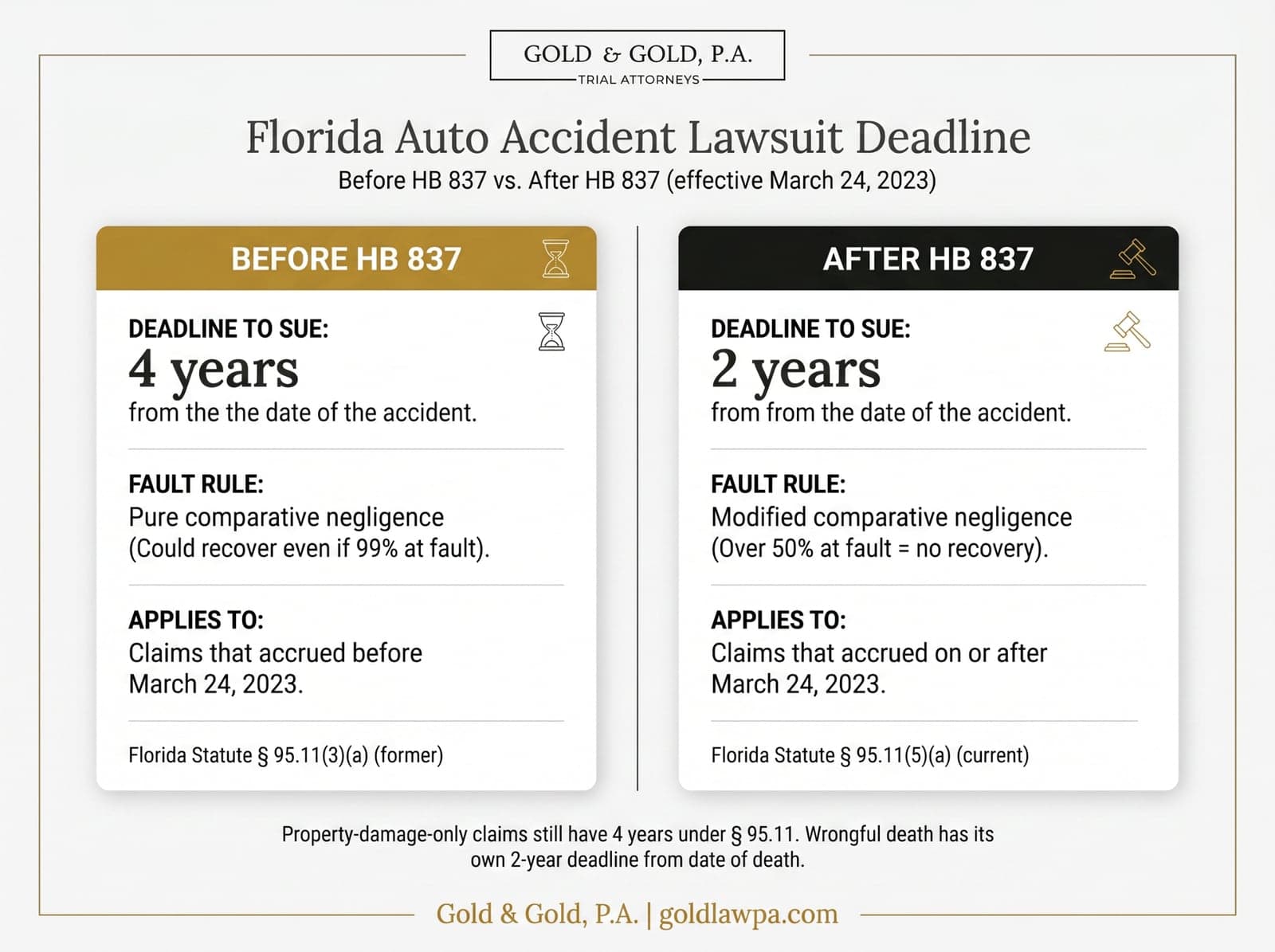
Florida cut its lawsuit deadline in half in 2023, and most people still don't know it. The old rule gave you four years from the date of an accident to file suit. The new rule gives you two. If your accident happened on or after March 24, 2023, the shorter clock applies to you, whether you have heard about the change or not.
This matters because the deadline does not wait for you to finish treatment, finish negotiating with the insurance company, or feel ready. The clock starts on the day of the crash. If you miss it, courts dismiss the case regardless of how badly you were hurt or how clear the other driver's fault was.
This article walks through the deadline, the exceptions that can pause it, what happens if you miss it, and what a Florida auto accident lawsuit actually looks like if you decide to file. At Gold & Gold, P.A., we have handled Florida auto accident cases under both the former four-year statute of limitations and the current two-year deadline. One of the most common mistakes we see is accident victims assuming they have more time than they actually do.
How Long Do You Have to Sue After a Car Accident in Florida?
Two years from the date of the accident, for most negligence-based personal injury claims. That deadline is set by Florida Statute section 95.11(5)(a), as amended by House Bill 837, the tort reform law Governor Ron DeSantis signed on March 24, 2023.
Two years sounds like a long time. It is not. Most cases involve months of medical treatment, weeks of insurance negotiation, and time spent simply recovering. Two years compresses all of that and still expects a lawsuit to be filed at the end if a fair settlement has not been reached. The earlier a lawyer is involved, the more of that two years gets used productively. At Gold & Gold, P.A., we encourage clients to understand the statute of limitations early so they can focus on treatment and recovery while their legal team manages the deadlines.
Why the Florida Statute of Limitations Changed in 2023
House Bill 837 was the most significant tort reform package Florida has passed in decades. The two-year deadline is one of several changes it brought. Other changes included the shift from pure comparative negligence to modified comparative negligence (the 50% bar), changes to how bad faith insurance claims are litigated, and new rules around negligent security cases.
Supporters argued the changes would reduce insurance costs and curb litigation. Critics argued they shift the balance of power toward insurers and away from injured people. Regardless of where you stand on the policy debate, the practical reality is the same: people injured in Florida car accidents now have less time to protect their rights and pursue a personal injury lawsuit.
What Starts the Clock?
In almost every Florida auto accident case, the clock starts the day of the accident itself. Not when you noticed the injury. Not when your medical treatment ended. Not when the insurance company denied your claim. The day of the crash. At Gold & Gold, P.A., we frequently speak with people who mistakenly believe ongoing insurance negotiations extend the deadline. They do not.
The most common misconceptions that cause people to miss the deadline:
- The clock does not wait for you to finish medical treatment.
- The clock does not pause while your insurance claim is being negotiated.
- The clock does not reset when an insurer denies your claim.
- The clock does not wait for you to feel emotionally ready to file.
- The clock does not extend just because you did not know about the 2023 law change.
What If I Did Not Know I Was Injured Right Away?
Some injuries do not show up on the day of the crash. Soft tissue damage, traumatic brain injuries, and certain spinal injuries can take days or weeks to fully appear. Florida law allows a narrow discovery rule in some cases, where the clock can start when the injury was discovered or reasonably should have been discovered. This is most clearly recognized in medical malpractice cases. For ordinary negligence claims like a car accident, courts typically apply the statute of limitations strictly to the date of the accident.
Bottom line: do not assume the discovery rule will save you. Get medical attention quickly, document everything, and treat the date of the accident as the date your statute of limitations began running. Always assume the two-year deadline applies to you unless an attorney confirms otherwise after reviewing the facts.
At Gold & Gold, P.A., we review potential deadline issues early so clients understand exactly how much time they have to act.
What Happens If You Miss the Deadline?
Your case is dismissed. Florida courts enforce the statute of limitations strictly. If the deadline has expired, the defendant will likely raise the statute of limitations as a defense, which can prevent you from recovering compensation regardless of the strength of your underlying claim.
There is no extension simply because insurance negotiations were ongoing or because you were unaware of the filing deadline.
How a Florida Car Accident Lawsuit Works
Most people searching how to sue after an auto accident do not actually want to file a lawsuit. They want to know what would happen if they did. Here is what an auto accident lawsuit in Florida actually looks like.
- Hire a lawyer. Pre-suit, your lawyer investigates the accident, gathers your medical records, identifies witnesses, and calculates the full value of your damages. Most of this happens before any lawsuit is filed. The first consultation is free; there is no fee unless the case recovers. At Gold & Gold, P.A., much of the work that strengthens a case happens before a lawsuit is ever filed.
- The demand letter. Your lawyer sends a formal demand to the at-fault driver's insurance company. The demand lays out the facts, the injuries, the damages, and what it would take to settle. A meaningful share of cases settle here without a lawsuit ever being filed. This is also where the 'how to write a demand letter for an auto accident settlement' question lives.
- File the complaint. If the insurer refuses to make a fair offer, your lawyer files a complaint in the appropriate Florida circuit court. This step is what stops the statute of limitations clock. As long as the complaint is filed before the two-year deadline, the case proceeds even if the rest of the process takes longer.
- Service of process. The defendant is officially served with the lawsuit. They have 20 days to respond. The case is now active in court.
- Discovery. Both sides exchange documents, take depositions, and gather expert opinions. This is usually the longest stage of a lawsuit, often 6 to 12 months. It is also where the case strengthens or weakens significantly based on what gets uncovered.
- Mediation. Florida courts require mediation in most personal injury cases before trial. A neutral third party helps both sides try to settle. Many personal injury lawsuits resolve during mediation after both sides have had an opportunity to evaluate the evidence and risks of continuing litigation.
- Trial, if needed. Most cases settle before trial. The cases that go to trial typically do so because the insurance company refused to offer fair value, and the plaintiff's lawyer was prepared to take the case in front of a jury. The threat of trial is what produces fair settlements in the cases that settle.
From filing to resolution, most Florida auto accident lawsuits take 12 to 24 months. Complex cases, multi-defendant cases, and trucking cases can take longer.
Can You Sue in Small Claims Court for an Auto Accident?
In Florida, small claims court handles cases up to $8,000 in damages under Florida Small Claims Rule 7.010. Auto accident cases with any meaningful injury exceed that limit almost immediately, between the ER bill, follow-up care, and lost wages. That is why personal injury claims are not filed in small claims court.
Property-damage-only cases with no injury and minor damage can sometimes fit within the limit. Most are handled through insurance without ever going to court at all. If your only loss is a few thousand dollars in vehicle repairs and the insurance side is not working, small claims is an option. For anything beyond that, you are looking at circuit court.
What If You Are Being Sued for an Auto Accident?
Being served with a lawsuit is alarming. Most people who search "why am I being sued for an auto accident" have never dealt with litigation before and do not know what to do. The short answer: do not ignore it and do not delay. At Gold & Gold, P.A., we recommend contacting your insurance company and seeking legal guidance immediately after being served with a lawsuit.
- Notify your insurance company immediately. Your auto insurance policy includes a duty to defend you. The insurer will assign a defense lawyer at no cost to you. This is part of what your premiums pay for.
- Do not ignore the lawsuit. If you do not respond by the deadline (usually 20 days from being served), the court can enter a default judgment against you. Default judgments are very difficult to undo and can result in liens, wage garnishment, or asset seizure depending on the amount.
- Understand that you can be sued personally. If the plaintiff's damages exceed your insurance policy limits, or if you were driving uninsured or outside your coverage, you can be held personally liable for the difference. This is why having adequate coverage and understanding your policy matters.
- Know that you can hire your own lawyer. The insurance company's defense lawyer represents your interests in defending against the lawsuit, but their primary client is the insurer. If your interests diverge from the insurer's, especially in cases where damages might exceed your policy limits, you have the right to hire independent counsel.
If you have been served with an auto accident lawsuit, the right call is to a lawyer the same day. Do not wait for the response deadline to start ticking down.
Frequently Asked Questions
How long after an auto accident do you have to sue in Florida?
How long does an auto accident lawsuit take in Florida?
Can you still settle a claim after the statute of limitations expires?
How long do you have to report an auto accident to the police in Florida?
What if my accident was right around March 24, 2023?
Understanding Florida's Two-Year Deadline
Two years. For Florida auto accident lawsuits arising from crashes that occurred on or after March 24, 2023, that is the time you have to file a claim.
The deadline arrives faster than many people expect. Medical treatment, insurance negotiations, and day-to-day recovery can consume months before you realize how quickly the statute of limitations is approaching.
The best way to protect your rights is to understand your deadline early and take action before time becomes a problem.
Gold & Gold, P.A., has handled Florida auto accident cases under both the former four-year statute and the current two-year statute. If you were injured in a Florida car accident and are unsure how much time remains to file your claim, contact Gold & Gold, P.A., for a free consultation. We can review your situation, explain the applicable deadlines, and help you understand your legal options.
Injured and unsure of your next step?
Speak with a trial attorney today. Free, confidential, and no fee unless we win.